Thursday, July 7, 2011

hovering, in the background


St Luke by Vecellio Tiziano


The Word for today:
Acts 17:16-34

Throughout much of the New Testament, our eyes are fixed on Paul.  He's the central character in Acts 13-28.

He's also the author of half the "books" of the New Testament. (Immediately after Acts, we'll read a collection of letters Paul wrote to churches and individuals:  Romans, 1 and 2 Corinthians , Galatians, Ephesians, Philippians, Colossians, 1 and 2 Thessalonians, 1 and 2 Timothy, Titus, Philemon, and Hebrews (1).

But while Paul is the focus of our attention, the person who wrote more of the New Testament (2) than Paul (or anyone else) goes nearly unnoticed in the background.

It's 'Paul did this,' and 'Paul did that' throughout most of Acts.  But every once in a while, almost imperceptibly, the narrative slips into the first person plural, reminding us that the author of Acts isn't Paul, but Luke:

Paul and his companions traveled throughout the region of Phrygia and Galatia. They passed by Mysia and went down to Troas. During the night Paul had a vision of a man of Macedonia standing and begging him, "Come over to Macedonia and help us." After Paul had seen the vision, we got ready at once to leave for Macedonia, concluding that God had called us to preach the gospel to them. (see Acts 16:6-10)

Only in chapters 16, 21, and 28 does a pronoun referring to Luke find its way into Acts.  His name never appears--neither in Acts nor in the gospel he wrote.  He was reporting throughout the bulk of the New Testament, but you'd hardly know he was in the picture.

How perfect an illustration of the Holy Spirit, who shines a light on Jesus but rarely on himself.   And how worthy an aspiration for us--to (along with John the Baptist) become less and less, while he becomes greater and greater (3).

~~~~~~~~~~~~~~~~~~~
(1) the authorship of Hebrews is uncertain; (2) while Paul wrote the most New Testament "books," Luke wrote the most words (3) John 3:30

Wednesday, July 6, 2011

Contradictions?--part 2


The Word for today:
Acts 17:1-15

Yesterday, we thought we spotted a contradiction when Paul had Timothy circumcised.  Had Paul resorted to a salvation by works?

NO WAY!  We found out that Timothy could take it or leave it.  If circumcision made it easier to work with the Jews, then he could "take it"--and so he did.  But it had no bearing on Timothy's salvation.

Today we spotted another apparent discrepancy.  Paul and Silas are in prison, praying and singing hymns to God around midnight, when a dramatic scene ensued:


Suddenly there was such a violent earthquake that the foundations of the prison were shaken. At once all the prison doors flew open, and everybody's chains came loose. The jailer woke up, and when he saw the prison doors open, he drew his sword and was about to kill himself because he thought the prisoners had escaped. But Paul shouted, "Don't harm yourself! We are all here!"
The jailer called for lights, rushed in and fell trembling before Paul and Silas. He then brought them out and asked, "Sirs, what must I do to be saved?" 
They replied, "Believe in the Lord Jesus, and you will be saved--you and your household."  (Acts 16:26-31)

Wait a minute!  Does this teach that if Dad (or Mom) is saved, then the rest of the family is saved too?

NO WAY!
The sense of the passage is: 'You will be saved and if your household believes, they will be saved.'  So teach your children that each individual is responsible for his own decision.  The need for each person to have an individual relationship with Jesus is confirmed in the verse immediately following:

Then they spoke the word of the Lord to him and to all the others in his house. At that hour of the night the jailer took them and washed their wounds; then immediately he and all his family were baptized. The jailer brought them into his house and set a meal before them; he was filled with joy because he had come to believe in God--he and his whole family. (Acts 16:32-34)


The precept to remember is this:
 When a "stray" verse seems to contradict the weight of biblical teaching, it doesn't!  

As a beginning Bible student, I thought I'd found contradictions left and right.  But over the years, I found out that almost every "contradiction" represented a limitation on my part.  It was often my limited understanding of the context.  

Or it was my half-formed understanding of some biblical concept.  Later, when my understanding of that concept became fully-formed, the Bible stopped making mistakes!

Funny how that works.

~~~~~~~~~~~~~~~~~~~~~~~~~~

Tuesday, July 5, 2011

Contradictions?--part 1


The Word for today:
Acts 16:16-40

Back in chapter 15, there was great contention about circumcision:
Some men came from Judea to Antioch and started teaching the believers, "You cannot be saved unless you are circumcised as the Law of Moses requires."
Paul and Barnabas got into a fierce argument with them about this, so it was decided that Paul and Barnabas and some of the others in Antioch should go to Jerusalem and see the apostles and elders about this matter.  (Acts 15:1-2)

In Antioch, it was decided by a council of church leaders that the Gentiles would not be required to maintain Jewish laws.  James, their spokesman, delivered their decision:
"We understand that some men from here have troubled you and upset you with their teaching, but they had no such instructions from us. The Holy Spirit has shown us that we should not place any extra burden on you."  (Acts 15:24, 28)

***

So what, pray tell, is going on in Acts 16:3:
Paul wanted Timothy to travel with him, but all the Jews living in that area knew that Timothy's father was Greek. So Paul circumcised Timothy to please the Jews. 

Is Paul now requiring faith and works (circumcision) for salvation?  The answer is a definite NO!

Paul had Timothy circumcised so that it would not become an issue in Timothy’s ministry with the Jews.  It had no bearing on Timothy's salvation. 

There are fundamentals of the faith in which there can be no deviation.  However, there are various forms and rituals (baptism is an example) which are not essential to salvation and where there is a great deal of flexibility. 

A good Bible-teaching church-- which teaches salvation only through faith in Jesus Christ, and provides opportunity to serve and to grow in grace and in the knowledge of the truth--is as good as it gets, no matter their forms and traditions of worship. 


~~~~~~~~~~~~~~~~~~~~

Monday, July 4, 2011

unlikely church planters


(by Pastor Joe)

The Word for Today: Acts 16:6-15
Mark this: Philippians 1:3-6
I thank my God every time I remember you. In all my prayers for all of you, I always pray with joy because of your partnership in the gospel from the first day until now, being confident of this, that he who began a good work in you will carry it on to completion until the day of Christ Jesus.


At the beginning of Paul & Silas' missionary journey, I doubt that the city of Philippi was on their mind. Sure, it was "a Roman colony, and the leading city" of its district, but it was by no means a Rome or an Athens or even a Corinth. Apparently Paul had a mind to head north towards Bithynia - but the Holy Spirit said "nope!" So he ends up in Philippi of all places.

There wasn't much of Jewish population there, seeing as there was no synagogue (which required a minimum of ten men). So instead of following his usual pattern of starting ministry in a synagogue, Paul & Silas head instead outside the city to the river. Who's there?
Important city officials? Great scholars? Experts in philosophy or religion? Nope- just a bunch of women. No one of significance to the Roman world- but remember- God is no respecter of persons(1) (After all, my particular church was started by the ministry of two women!)

From these humble beginnings, comes a thriving church, one that brought much encouragement and support for Paul. His affection for this particular congregation leaps off the page in the letter to the Philippians. From the very beginning, they were his partners in the Gospel. They gave generously. He calls them dear friends and fellow workers. (2)

All this started from a businesswoman named Lydia, some other women, a converted jailer and his household. (3) None of these would were likely candidates for planting a church, and yet that is exactly what they did. Today, the book of Philippians is know as Paul's joy letter. And this rag tag band of church planters gives me great joy as well because it confirms that the Gospel never rests "on men's wisdom, but on God's power." (4)

*********************
(1) Acts 10:34
(2) Philippians 1:4, , 4:1-3, 4:15
(3) Acts 16:34
(4) 1 Corinthians 2:5

Sunday, July 3, 2011

welcome to Splitsville


(by Pastor Joe)

The Word for Today: Acts 15:36-16:6

Mark this: Romans 8:28
"And we know in all things God works for the good of those who love Him, who have been called according to His purpose"

Not many of us like arguments. Debate teams are in serious decline in our country. But the Bible and the book of Acts is full of them. The apostles versus the chief priests. The Greek widows versus the Hebrew widows. The chief priests versus Stephen. Peter et al versus the "circumcision happy" crowd. Its not quite Tom and Jerry, but there is a fair amount of tension.

Today's spat may be the most famous one in Acts: Paul versus Barnabas. In a recent blog (June 27th), Franklyn helps us to see much of the back story of this argument. We see how John Mark faltered during Paul & Barnabas' first missionary journey. When the going got tough, John Mark got going, all the way back to mama (1).

Now after the council in Jerusalem, and some time in Antioch, Paul and Barnabas are ready to begin a second missionary journey. But there is a problem with the team make up, and the problem is with John Mark. After the debacle in Pamphylia, Paul was not ready to have him back on the team. But Barnabas, forever the encourager, wanted to restore his troubled cousin (2).

Paul thought Barnabas was being too soft.
Barnabas thought Paul was being too harsh.
Perhaps they both were right.
In either case, it was splitsville for the dynamic duo of Paul & Barnabas.
The end of an era, a major blow to this young movement of God.

Or is it?

I am not saying that Paul or Barnabas were completely innocent here. Somewhere there was a failure of trust and communication, that, I am sure, both of them regretted. But that is exactly where God comes in.

Think back to Romans 8:28.
Did both Paul & Barnabas love God? YES
Were both Paul & Barnabas called according to His purpose? YES
Therefore, God worked out even this little quarrel for good.

How?
1. We go from one to two mission teams.
Paul finds a very capable partner in Silas, and they head to Syria.
Barnabas rounds up John Mark and they are off to Cyprus. You say division- I say multiplication.

2. John Mark is both rebuked and restored at the same time.
After the stunt he pulled, Paul could not pretend that everything was peachy.
Yet that bit of cowardice is not the final chapter on John Mark's life, and he graciously gets a second chance. How grateful are we for Paul's comments about John Mark at the end of his life- recognizing this truth (3)

Our God is gloriously sovereign- and able to use everything- including all our blunders and failures and stupidity for His purpose. So next time you think that some sort of roadblock, fall out, relationship failure, or argument has somehow ruined you or God's kingdom in and around you- think again. Some of God's greatest works are directly from our scrapheaps.

*****************************
(1) Acts
(2) Colossians 4:10

(3) 2 Timothy 4:11

Saturday, July 2, 2011

the decision (50 AD)


(by Pastor Joe)

The Word for Today: Acts 15:13-35

I am sure that all of us have seen our share of bad TV (programming so mind-numbingly terrible that we want a refund on our time). Alas, no such refund exists, which is why it may be wise to kill your television before its to late. Here are my top three TV debacles:

1. On April 21, 1986, thirty million Americans (including me) watched Geraldo Riviera painfully destroy two hours of our lives trying to open Al Capone's lost vault, only to find a whole lot of nothing.

2. In the early 2000's, Fox cooked up an equally awful special entitled "Man vs. Beast" that pitted an world class sprinter versus a Zebra in the 100 meter dash. Noted singer and Olympian Carl Lewis acted as commentator for the event, and offered this profound insight "The key to victory for the Zebra is for the Zebra to recognize that this is a race." (The zebra won by 5 lengths!)

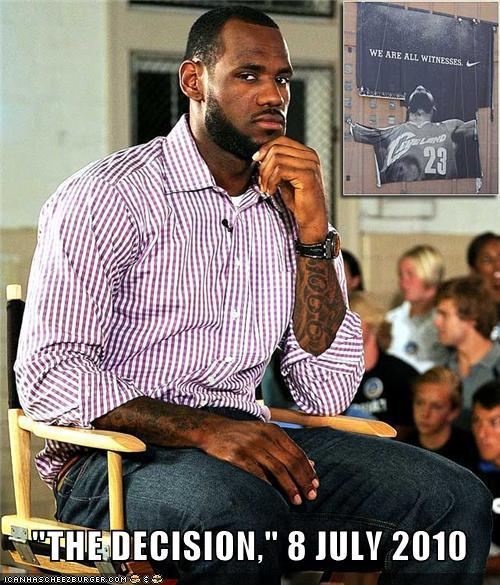
3. But the worst waste of time involving a television in recent memory, was entitled "The Decision" (pictured above) . Here, basketball superstar Lebron James took one hour to uncomfortably tell the world that he was taking his "talents to South Beach." What could have been told in one minute was instead dragged out into sixty, further insulting the beleaguered city of Cleveland as they helplessly watched their hometown hero bolt for Miami.

Today, we are looking another "decision.," but one much more difficult and much more important. In fact for any of you fellow Gentiles (non Jews) out there, the only reason you are reading this blog relates directly to this decision, some 1950 years later. This decision takes place in Jerusalem, where the differing sides bring reasons for their positions, and after consideration the church makes the decision on what to do.

The issue was much more than circumcision, it really was this: "Must a person become a Jew first before becoming a Christian? Was the Gospel only open to those who were connected to Judaism in some way?" Some of the folks in the early church would say "yes" to both the above questions. After all, Jesus was a Jew, as were His Apostles, and near every believer to this point. Even Gentiles like Cornelius were already connected to Judaism. Remember he was "well spoken of by the whole Jewish nation ."(1) This side certainly wanted to honor the Word of God (which, up to this point, was the Old Testament).

On the opposite side, we have an amazing team of Paul, Barnabas and Peter, who likewise greatly honor the Old Testament, and use it to show that salvation is indeed for the Gentiles.
First Peter gives shares his encounter with Cornelius and other Gentiles, how they heard the Gospel, believed in Jesus Christ, were filled with the Holy Spirit, and baptized (2), exactly the same way that believers of a Jewish background had. His point: Why bother trying to make a distinction if God Himself had not? God did not require these Gentiles to be circumcised in order to be saved.

Next Barnabas and Paul share their work among the Gentiles, and how God worked in great ways to reach them, again, without any cultural distiction.

Finally James, the half-brother of Jesus (3), quoting from the prophet Amos, shows that Gentiles are indeed welcomed by God. The decision is made: we are all, Jews and Gentiles alike, saved not by keeping any certain rules, but through "the grace of the Lord Jesus (4)."

[The only caveat is that these new Gentile Christians must be sensitive to the culture of the Jewish Christians around them. They are told that they must abstain, for the sake of their witness, and the sake of the culture they live in, from particularly offensive behaviors that would cause others to stumble. Good advice. This is the same kind of thing as when missionaries are sensitive to the cultures they are serving in. You wouldn't offer a Hindu a cheeseburger, or take a Muslim to a pork roast, or touch someone with your left hand out in the African bush. Converts to Christ would need to know that in the family that they have joined, certain types of food, idolatry and sexual immorality would be reprehensible. ]

This decision is ground-breaking, not only for its time, but also in history. Because of it, Christianity was, and is, able to grow beyond every single national, political, and cultural barrier. Because of this decision, we are not locked into a particular culture or geography (as Islam, Hinduism, and pretty much every other major religion is). Because of this decision, I myself was, however indirectly, able to hear and receive the Good News that Jesus Christ died for everyone, even old me. Thank you Peter, Barnabas, Paul & James. Thank you even more, Holy Spirit, for enabling your people to make the right decision.

~~~~~~~~~~~~~~~~~~~~
(1) Acts 10:22
(2) Acts 10:44-48
(3) Matthew 13:55
(4) Acts 15:11

Friday, July 1, 2011

the Good News: read all about it, part 3


The Word for today:
Acts 15:1-12

mark this:  Acts 14:7
And there they preached the Good News.

Over the last couple of days, we took a look at what the Bible means by "the Good News" (also know as "the gospel.")

The Apostle Paul stressed that the Good News--Jesus' life, death, and resurrection--had been written in the Old Testament (which were the only "Scriptures" Paul had).
And now I want to remind you, my friends, of the Good News which I preached to you, which you received, and on which your faith stands firm. That is the gospel, the message that I preached to you: that Christ died for our sins, as written in the Scriptures; that he was buried and that he was raised to life three days later, as written in the Scriptures.  (1 Corinthians 15:1-4)

Jesus proclaimed the Good News with the greatest clarity, because--in the Sermon on the Mount-- he was able to paint the darkest background in scripture:
"You have heard that it was said to those of old, 'You shall not murder; and whoever murders will be liable to judgment.' But I say to you that everyone who is angry with his brother will be liable to judgment; whoever insults his brother will be liable to the council; and whoever says, 'You fool!' will be liable to the hell of fire. 

"You have heard that it was said, 'You shall not commit adultery.' But I say to you that everyone who looks at a woman with lustful intent has already committed adultery with her in his heart. If your right eye causes you to sin, tear it out and throw it away. For it is better that you lose one of your members than that your whole body be thrown into hell. And if your right hand causes you to sin, cut it off and throw it away. For it is better that you lose one of your members than that your whole body go into hell.   (see Matthew 5:21-30)

Against that hyper-darkness, the Light off the World shines even brighter, the Good News sounds even better.

***

The Good News should be told like Jesus told it.  It can't be painted in colors all sweet and light, because we can't perceive it against that background.  The telling that will be heard, the telling that will engender faith, will be the telling of the whole Word of God:
So then faith comes by hearing, and hearing by the word of God. (Romans 10:17)

The Good News should be told like Jesus told it.  He ratcheted up the law to the nth degree, in order that we could perceive the grace of God more clearly:
Law came in, to increase the trespass; but where sin increased, grace abounded all the more. (Romans 5:20)

Then he played the John 3:16 card.

He knew how to tell the Good News because he is the Good News:
And daily in the temple, and in every house, they ceased not to teach and preach Jesus Christ.  (Acts 5:42)

~~~~~~~~~~~~~~~~~~~~~~