Sunday, June 25, 2017

the voice behind the Word

The Word for today:
Exodus 19, 20
mark this: Exodus 20:2-3
"I am the LORD your God, who brought you out of the land of Egypt, out of the house of slavery. You shall have no other gods before me."
I don't often wonder what God looks like. What I really need to know is what he sounds like.
The Word of God in paper form seldom indicates tone of voice. Other than the surrounding context, we are left to guess whether a word is said matter-of-factly, or ironically, or wistfully, or regretfully, or…
But those who believe in Jesus can discern his actual voice:
And when he brings out his own sheep, he goes before them; and the sheep follow him, for they know his voice. (John 10:4)
The Old Testament uses a figure of speech to convey the same principle. Believers, we are told, have a blood-tipped ear (1)--an ear that is tuned in to the wavelength of the Holy Spirit. The blood-tipped ear "hears" the voice behind the words, while the unbeliever only sees the printed text:
But the natural man does not receive the things of the Spirit of God, for they are foolishness to him; nor can he know them, because they are spiritually discerned. (1Corinthians 2:14)
A good example of how the blood-tipped ear hears God's tone of voice is found in the First Commandment. The First Commandment is actually found in various places in your Bible. It is first pronounced in Exodus:
"I am the LORD your God, who brought you out of the land of Egypt, out of the house of slavery. You shall have no other gods before me." (Exodus 20:2-3)
Jesus pronounces it in the gospel of John:
"I am the way, and the truth, and the life. No one comes to the Father except through me." (John 14:6)
The Holy Spirit (speaking through Peter) pronounces it in Acts:
"There is salvation in no one else, for there is no other name under heaven given among men by which we must be saved." (Acts 4:12)
The natural eye reads the First Commandment as narrow, restrictive, and exclusive. But the blood-tipped ear will come to hear those same words sound like this:
"Follow me, keep your eyes on me. I know the way out of here. But if you lose sight of me, if you lose track of me, you won't get out alive." (2)
It's a miracle! The blood-tipped ear hears love in the law. It's the "audio" equivalent of turning water into wine.
~~~~~~~~~~~~~~~~~~~~~~~~~
(1) Exodus 29:20: (2) Cf. Genesis 19:17 and 2 Chronicles 20:12.

Saturday, June 24, 2017

unlikely nourishment -- pt. 2

(by Pastor Joe)
The Word for Today: Exodus 18
mark this: 1 Corinthians 10:3-4
"They all ate the same spiritual food and drank the same spiritual drink; for they drank from the spiritual rock that accompanied them, and that rock was Christ."
Life is complicated--we get that. But the Word of God is not. It certainly is at times complex, or even minutely detailed, but never so complicated that we need some sort of secret knowledge or special degree. The rule of thumb is: keep it simple. But that is difficult in this day and age. Never have we as a people had such instantaneous access to information. Ironically, all that info has only served to further confuse us.
British journalist Malcolm Muggeridge, concerning our modern times, wrote: "We have educated ourselves into imbecility." You can find plentiful evidence for this in our political and educational systems, but the sad truth is that this effect has carried over to Christians as well. There is no end to all of our books and programs and commentaries and paraphernalia, but our people seem to be growing further from, not closer to, the basic truths of our faith.
That is why I am grateful for this amazing book of Exodus, where we see the Israelites experience, physically, what we as followers of Christ experience spiritually. They are, in many ways, our "guinea pigs," as we learn from their experience and mistakes. In the past four blogs, Franklyn has done a brilliant job of bringing out how fundamental the accounts of the Passover, the Exodus, and the Red Sea are to us some 3,5oo+ years later. All of these events point us to Christ.
Yesterday we focused on the connection between Christ and the manna. Today, we are looking at the water. The Israelites encounter two liquid problems in these chapters- the bitter waters of Marah, and the lack of water in Rephidim.
Both times, God provides--and as he does, he points us again to Jesus. At Marah, Moses is instructed to throw a chunk of wood, of all things, into the waters to take away the bitterness. Years later, God uses a chunk of wood, of all things, to defeat sin (1).
At Rephidim, Moses is instructed, of all things, to strike a rock and out would come water. This was essential for the Israelites, but it only temporarily quenched their thirst. Years later, Jesus said to a woman by a well, "Everyone who drinks this water will be thirsty again, but whoever drinks the water I give him will never thirst. Indeed, the water I give him will become in him a spring of water welling up to eternal life (2) ."
And so Exodus, while indeed the account of how God rescued and redeemed the people of Israel from Egypt, is even more fundamentally about His Son, Jesus. Through it we learn that Jesus is our true food and Jesus is our true drink, because only Christ truly satisfies and only Christ truly lasts forever.
~~~~~~~~~~~~~~~~~~
(1) Galatians 3:13
(2) John 4:13-14

Friday, June 23, 2017

unlikely nourishment -- part 1

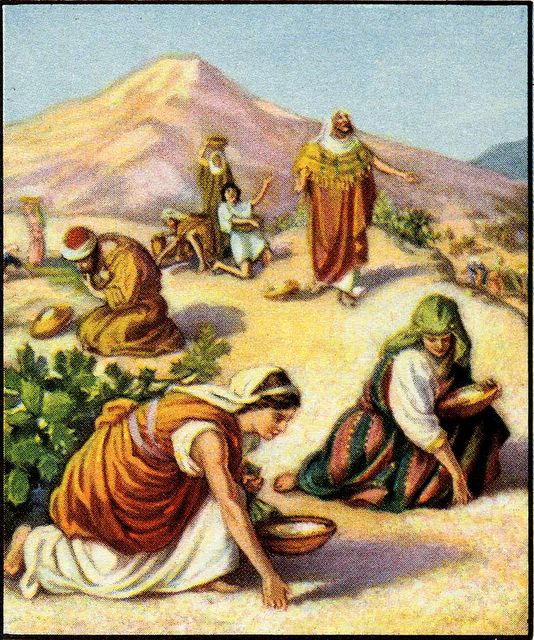
Gathering Manna -- Exodus 16:14-31
(by Pastor Joe)
The Word for Today: Exodus 17
mark this: 1 Corinthians 10:3-4
"They all ate the same spiritual food and drank the same spiritual drink; for they drank from the spiritual rock that accompanied them, and that rock was Christ."
Like the accounts of Genesis, the importance of the stories in the first half of Exodus cannot be understated. These first 70 chapters are the very building blocks for the entire rest of the Bible. If we don't get them, that is like showing up in Algebra or Calculus class not knowing how to add or subtract. Good luck with that.
In the past few days, we've learned from Franklyn how Passover teaches us the power in the blood, how hyssop teaches us that faith is merely the applicator, how the crossing of the Red Sea, a type of baptism, teaches us about deliverance and redemption.
Today and tomorrow, we are going to take a quick look at another lesson from the simplest of elements: bread and water.
It has been quite a whirlwind for the people of Israel since this fellow Moses showed up, claiming to have met with God. But God has backed up Moses' claims--in the plagues upon Egypt, in the final plague that lead to their exit, in the Pillar of Cloud and Fire, in the miraculous crossing of the Sea. But strangely enough, instead of being forever grateful, we find the Israelites grumbling against God and Moses.
First they whined about the lack of fresh water at Marah (1).
Then they complained about lack of food (2).
In today's passage they're back to bellyaching about water again.
Sadly, this pattern will continue for an entire generation.
But I want to focus not on all the griping, but rather on God's response. He takes these times to point His people, and ultimately us, to His Son. First the bread. God knows that His people have to eat, and so He develops an ingenious method: Manna. There's no better way to feed such a large group of wandering people.
What is it? Well, that's its name. We know what it looked like and even what it tasted like (3), but sadly the jar kept by Aaron is no longer available for a complete analysis. God took care of His people by raining down "bread from heaven (4)."
But this food, even though it was the "bread of angels (5)" could not ultimately satisfy. Instead, it points us to the ultimate Bread of Life, Jesus. He is our sustenance, both day after day, and for all eternity:
"I am the bread of life.
Your fathers ate the manna in the wilderness, and they died. 

This is the bread that comes down from heaven, so that one may eat of it and not die.
I am the living bread that came down from heaven. If anyone eats of this bread, he will live forever. And the bread that I will give for the life of the world is my flesh." (John 6:48-51)
~~~~~~~~~~~~~~~~~~~~~~
(1) Exodus 15:22-24
(2) Exodus 16:1-3
(3) Exodus 16:31
(4) Exodus 16:4
(5) Psalm 78:25

Thursday, June 22, 2017

he's got your back -- part 2

The Word for today:
Exodus 15:22-16:36
mark this:
The LORD is a warrior;
Pharaoh's chariots and his army
he has hurled into the sea.
 (Exodus 15:3-4)
Today, we Stand in the Rain, in awe, as we watch the LORD fight for our deliverance.
Yesterday we saw him fight the host of Egypt. Today we will watch as he -- the King of the Jews, pre-figured by David -- single-handedly fights the ruler of this world (pre-figured by Goliath) on Israel's behalf. Then he will shield a single sinner from her accusers. Finally, alone on a cross, he will fight to the death for the salvation of our souls.
***
They were between the devil and the deep Red Sea. But the Angel of God, the pre-incarnate Jesus Christ, had their backs:
Then the Angel of God, who had been leading the people of Israel, moved to the rear of the camp. (Exodus 14:19)
The Angel physically positioned himself between Israel and their demise, turning their darkest day into their shining hour:
The pillar of cloud also moved from the front and stood behind them. The cloud settled between the Egyptian and Israelite camps. As darkness fell, the cloud turned to fire, lighting up the night. (14:19-20)
When the Angel fought, he fought alone. All of their "help," it seems, would only hinder his efforts:
"Don't be afraid. Just stand where you are and watch the LORD rescue you. The Egyptians that you see today will never be seen again. The LORD himself will fight for you. You won't have to lift a finger in your defense!" (Exodus 14:13-14/NLT)
Later on, surrounded by three armies in the wilderness of Engedi, King Jehoshaphat would be told the same:
"Listen, King Jehoshaphat! Listen, all you people of Judah and Jerusalem! This is what the LORD says: Do not be afraid!
Don't be discouraged by this mighty army, for the battle is not yours, but God's. Tomorrow, march out against them. You will find them coming up through the ascent of Ziz at the end of the valley that opens into the wilderness of Jeruel.
But you will not even need to fight. Take your positions; then stand still and watch the LORD's victory.
He is with you, O people of Judah and Jerusalem. Do not be afraid or discouraged. Go out there tomorrow, for the LORD is with you!" (2 Chronicles 20:15-17)
***
When King David stood alone -- in the Valley of Elah, to fight in Israel's stead -- it was but a picture of the day when the King of Kings would stand for all of us against evil's entire array -- against the rulers, against the authorities, against the cosmic powers over this present darkness, against the spiritual forces of evil in the heavenly places. (Ephesians 6:12)
Disdaining the armor of the world, he chose the full armor of God:
the belt of truth, the breastplate of righteousness, the shield of faith, the helmet of salvation, and the sword of the Spirit, which is the word of God. (Ephesians 6:14-17; cf. 1 Sam. 17:38-39)
The only visible weapon he carried to the battle was a cross. They laughed him to scorn: Why, you might as well fight a giant with a slingshot!
You might as well, indeed. The principalities and powers could not perceive that his death would be their undoing; that his victory would be ours as well.
So he placed himself in harm's way, between death and the people, just as he had in Egypt, in Engedi, and in Elah.
***
He'd fought for all the people, against all the forces of evil, in Egypt and Engedi and Elah, at Gethsemane and Golgotha.
But, in his heart, when he fought alone, when he died alone,
he stood as shield (1) for you alone,
between a solitary sinner and her accusers (2), to deflect the rocks meant just for her.
~~~~~~~~~~~~~~~~~~

Wednesday, June 21, 2017

he's got your back -- part 1

The Word for today:
Exodus 14:1-15:21
mark this: Exodus 14:19
Then the Angel of God, who had been leading the people of Israel, moved to the rear of the camp.
and this: Exodus 15:3-4
The LORD is a warrior;
Pharaoh's chariots and his army
he has hurled into the sea.
Today is the longest day of the year. I never miss it, but Daisy always did.
Two of the great passages in American literature have to do with the brightest and darkest days of the year.
In "The Great Gatsby," Daisy Buchanan notes an unrequited longing:
"Do you ever wait for the longest day of the year and then miss it? I always wait for the longest day of the year and then miss it!"
In "Stopping by Woods on a Snowy Evening," Robert Frost is drawn to the unfathomable:
Whose woods these are I think I know.
His house is in the village though;
He will not see me stopping here
To watch his woods fill up with snow.
My little horse must think it queer
To stop without a farmhouse near
Between the woods and frozen lake
The darkest evening of the year...
June 21 and December 21 are six months apart on the calendar. But for Israel, their darkest day and their brightest day were one and the same…
They were caught between the devil and the deep Red Sea. Pharaoh's matchless forces had pursued them to the edge of doom. Hemmed in, they could not advance or retreat. They were about to be slaughtered. But wait!
Then the Angel of God, who had been leading the people of Israel, moved to the rear of the camp. (Exodus 14:19)
(An angel is a messenger or envoy, bringing God’s message and representing God to others. Jesus is the Angel of God in this sense: God didn’t send just another messenger, he sent the Messenger who is the Message--the Word of God Himself.)
The Angel physically positioned himself between Israel and their demise, turning their darkest day into their shining hour:
The pillar of cloud also moved from the front and stood behind them. The cloud settled between the Egyptian and Israelite camps. As darkness fell, the cloud turned to fire, lighting up the night. (Exodus 14:19-20)
The Angel had their backs:
The LORD is a warrior;
Pharaoh's chariots and his army
he has hurled into the sea. (Exodus 15:3-4)
It would not be the last time. Tomorrow we'll see him standing, alone, to defend the defenseless again and again.
~~~~~~~~~~~~~~~~~~~~

Tuesday, June 20, 2017

"When I see the blood, I will pass over." (part 2)

The Word for today:
Exodus 12:37-13:22
God and first-grade teachers know how human beings learn. You've noticed that books for little kids have lots of pictures in them, while college textbooks don't. In the same way, God placed the illustrations of the Old Testament before the explanations of the New Testament. He put the show before the tell.
The pictures of Passover and hyssop in Exodus 12 are the primary Old Testament illustrations of Jesus' cross and our faith. You and I may have a long way to go before we fully discern doctrinal dissertations, but we can learn "vicarious substitutionary atonement" from a fluffy little lamb; and we can learn to appropriate "providential propitiation" from a leafy little branch.
Yesterday we observed that the death angel passed over if the blood of the lamb had been applied to the door.
Today, we'll look at the applicator--a leafy hyssop branch, which is the Bible's clearest illustration of saving faith.
***
The classic picture of faith in the Bible is a hyssop branch. The people used it to daub the blood of a lamb on the doorposts:
Take a bunch of hyssop, dip it into the blood in the basin and put some of the blood on the top and on both sides of the doorframe. Not one of you shall go out the door of his house until morning. When I see the blood, I will pass over. (Exodus 12:13)
But it is essential to understand that it is the blood, not faith, that saves.
The problem with faith is that it can apply something other than the blood of Jesus. Let's suppose you took your hyssop branch and daubed whitewash over your door post.
That's what the Pharisees did. Over sinful hearts they painted a whitewash of their works. Jesus called them whitewashed tombs, full of dead men's bones (Matthew 23:27). The death angel saw no blood on their "thresholds," and did not pass over.
There are essentially three "faiths"--
1. Faith in nothing.
Make no mistake--faith in nothing is a faith, and it is held by many.
People who have this faith paint nothing on their doors. The death angel does not pass over.
2. Faith in a false something.
The Egyptians might have taken their hyssop and written the names of their many gods on their doors. The Pharisees, in the example above, thought they could cover up sin with their own good works. In neither case will the death angel pass over.
3. Faith in Jesus Christ.
This is the faith in evidence in Exodus 12. Heeding the word of the LORD, some took their hyssop and marked their doors with the blood of the lamb. The death angel saw the blood of the cross of Christ to come and passed over.
Of the three, only the third is what we call saving faith.
Listen carefully to Charles Spurgeon--a Brit from the 1800's, still known as "the Prince of Preachers":
"It is not thy hold on Christ that saves thee; it is Christ. It is not thy joy in Christ that saves thee; it is Christ. It is not even thy faith in Christ, though that be the instrument; it is Christ’s blood and merit."
***
Everyone has a hyssop branch. With it, you can paint nothing. Or you can paint something which is false and cannot save. Or you can paint the blood of Jesus.
Everyone has a hyssop branch. But God isn't looking for evidence of faith. He's looking for evidence of Jesus.
~~~~~~~~~~~~~~~~~~~~~~~

Monday, June 19, 2017

"When I see the blood, I will pass over." (part 1)

The Word for today:
Exodus 12: 1-36
I've learned more about the cross from Old Testament pictures than from New Testament explanations. That's why I don't know of a more important chapter in the Bible than Exodus 12.
The same goes for faith. What I know about faith I first learned from Old Testament portraits and illustrations.
I've subsequently added to my understanding by wrestling with New Testament explanations, but I remain convinced that until we understand Passover and hyssop, we won't understand how much grace and faith depend upon each other.
God and first-grade teachers know how human beings learn. You've noticed that books for little kids have lots of pictures in them, while college textbooks don't. In the same way, God placed the illustrations of the Old Testament before the explanations of the New Testament. He put the show before the tell.
That's why he placed pictures of Passover in Exodus 12, before we ever get to Romans and Galatians. And that's why he put hyssop ahead of Hebrews.
Over the next few days, we are going to look at Passover and hyssop. They are the primary Old Testament pictures of Jesus' cross and our faith. You and I may have a long way to go before we fully discern doctrinal dissertations, but we can learn "vicarious substitutionary atonement" from a fluffy little lamb; and we can learn to appropriate "providential propitiation" from a leafy little branch.
***
When I see the blood, I will pass over you. (Exodus 12:13)
The sacrificial lamb lived in the household for four days. It was observed over that time, inspected. There could be no flaw, no spot or blemish. The kids, no doubt, considered it their pet -- little Fluffy or Tuffy or Snowball. They were about to find out the cost of sin.
After four days their Father took the lamb, slit its throat, and the blood poured out into a basin on the floor at the door. Then a hyssop branch was taken and the blood was daubed on the posts and on the lintel--above the doorway.
The points of blood if connected form perpendicular lines--a cross. So when the death angel came through, he did not enter the threshold where the blood was applied:
When I see the blood, I will pass over.
They were not saved because they were the seed of Abraham (Matthew 3:9). God did not ask, 'Are you a child of Israel or a child of Egypt?' The Egyptians could have been saved. God is not going to ask what church we belonged to; He is going to see the blood--or not.
They were not saved because they were doing the best they could. God says, "When I see the blood."
They were not saved by their thoughts or feelings. When feelings go up and down, when fears and doubts pester us, they do not matter. All that matters is whether the blood is on the door.
Jesus shed his blood for every sinner:
God so loved the world that he gave his only Son...
But the blood isn't effective--it isn't received--unless it is personally applied:
God so loved the world that he gave his only Son....that whosoever believes in him would not perish. (John 3:16)
Jesus shed his blood for every sinner:
By grace you have been saved...
But the blood isn't effective--it isn't received--unless it is personally applied:
By grace you have been saved....through faith. (Ephesians 2:8)
All might have been saved. But all were not, for this house applied the blood, while that house did not.
Tomorrow, we'll look at the applicator--a leafy hyssop branch, which is the Bible's clearest illustration of saving faith.
~~~~~~~~~~~~~~~~~~~~~~~